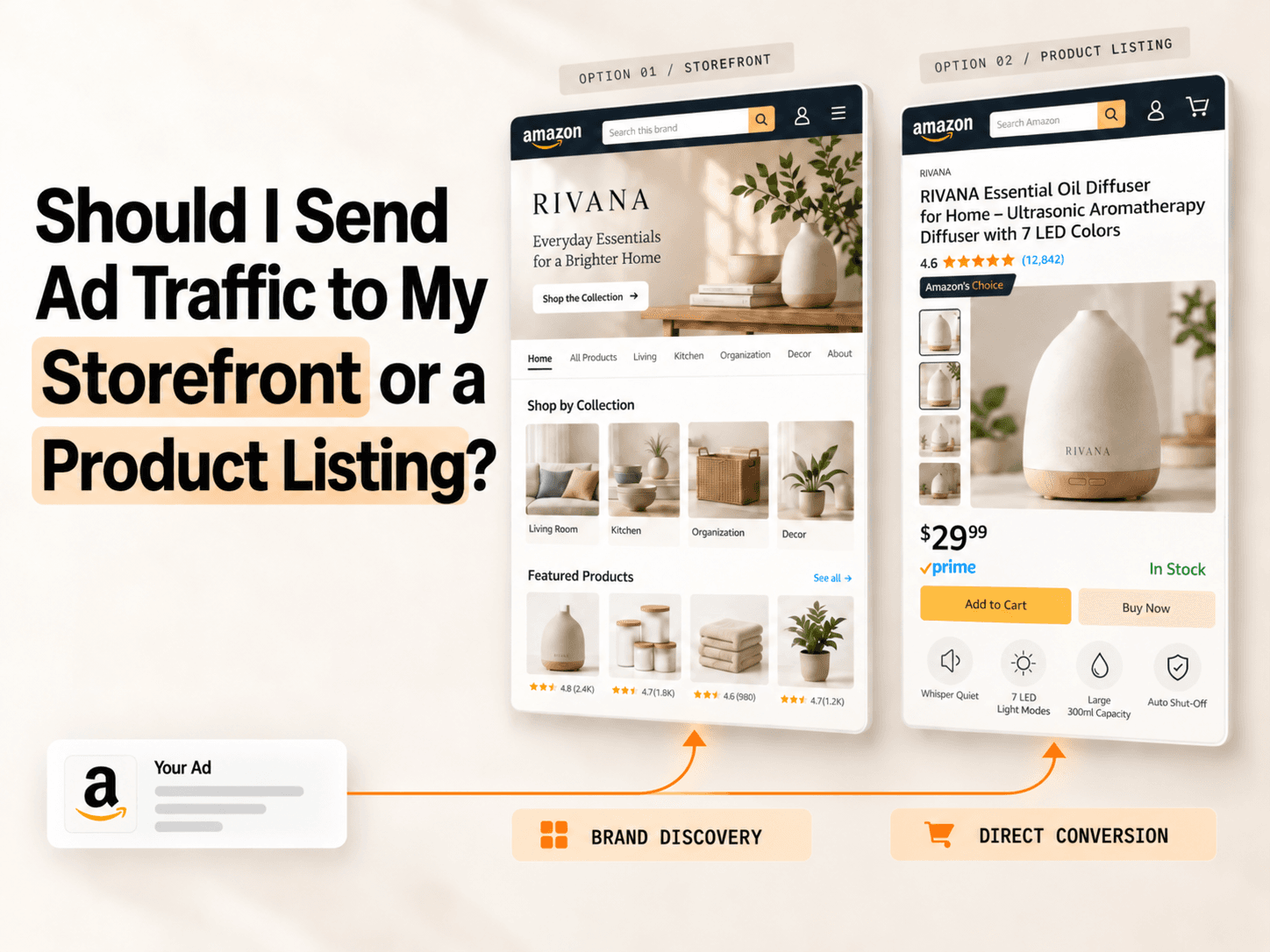
Should I Send Ad Traffic to My Storefront or a Product Listing?
Storefront vs product page is a keyword decision, not a coin toss. See which destination fits each ad type and catalog size, plus how to test it fairly.
- Written by
- WORKINX Studio
- Published
- 15 October 2026
- Read time
- 8 min
Your Sponsored Brands campaign spends $80 a day and you still second-guess the destination field. Amazon hands you the choice and no explanation of what it does to conversion.
Quick take: Match the destination to the keyword type and the ad format, not to a rule you read once. Most brands point every Sponsored Brands click at the Store homepage, which fits almost no keyword. One product when the shopper wants one item, a subpage when they are still choosing.
So why does storefront vs product page still feel like a coin flip?
Every dashboard offers the same dropdown: product detail page, Brand Store, or a landing page. Ask three people and you get three confident answers. So the destination gets set by habit, and nobody can say what the shopper was doing when the ad found them.
The short answer: match the destination to the keyword and the ad format
A destination is a match question: does the page answer what the shopper typed? A branded search and a category search are two different shoppers who need two different pages.
Product listing when the shopper wants one specific item
Someone typing your product name, or 'unscented dog chew for senior dogs,' wants that item. Send them straight to the detail page. Any extra step costs you.
Store subpage or three-product landing page when the shopper is still choosing
A category search is a browsing moment. The shopper is weighing sizes, flavors, or formats, and one detail page forces a decision they have not made yet. A curated subpage keeps three or four options inside your brand.
Store homepage only for branded searches and brand storytelling
Your homepage is a hallway, not a shelf. It works when someone already knows the brand. Point a category keyword at it and the shopper has to hunt, which they will not do.
What each ad type actually lets you choose
Before you pick a side in storefront vs product page, check what the format even allows.
- Sponsored Products always sends the click to the advertised product's detail page, with no destination setting (Amazon Ads, Sponsored Products).
- Sponsored Brands can land on a Brand Store, a product detail page, or a new landing page (Amazon Ads, Sponsored Brands guide).
- Store spotlight ads need a Brand Store with at least three sub-pages (Amazon Ads, Sponsored Brands guide).
- Product collection ads can use a new brand landing page of three or more products, with no Store required, since July 2024 (Amazon Ads, 2024).
- Custom landing pages are gone. Sponsored Brands stopped supporting them on June 30, 2021 (Amazon Ads, 2021).
Sponsored Brands Video splits the click in two: a tap on a product icon opens that item, a tap anywhere else opens the Store (Amazon Ads, 2023). One campaign, two destinations, one blended report.
What Amazon reports, and why practitioners disagree
The Store visitor numbers Amazon publishes
Amazon reports that advertisers linking Sponsored Brands to a Store saw shoppers spend twice as long there, detail page views up 55%, and sales up 15% across 25,000 US advertisers from November 2021 to March 2022 (Amazon Ads, Stores best practices). Store visitors buy 53.9% more often and carry a 71.3% higher average order value (Amazon Ads, Stores). New-to-brand shoppers who visited a Store were 62.7% more likely to purchase and spent 72.3% more per order (Amazon Ads, Stores).
Selection bias: those Store visitors were already warmer
None of those figures come from a controlled test. A shopper who clicks into a Store already decided your brand deserved a second look, which makes them a different person from the one who taps a single product. Treat the numbers as a reason to build a Store worth landing on, not as proof that a keyword belongs there.
Amazon's Store numbers describe the people who shop in Stores. They do not prove a Store improves the next shopper who arrives.
Why sending traffic to the Store fails when it means the homepage
Nielsen Norman Group has shown that people click whatever carries the strongest information scent and leave quickly when the page does not match the link they followed (NN/g, information scent). A Store homepage rarely matches a category keyword. The shopper searched 'collagen powder for women over 40' and landed on a grid of eight products.
Storefront vs product page: the decision by keyword type
Branded search. Send it to the homepage or a brand subpage and watch new-to-brand orders.
Category search. Use a subpage when two or more products fit the term. Hypothesis: these shoppers compare before choosing, so holding the comparison inside your catalog adds orders per session. Conversion holding while sessions rise tells you it worked.
Competitor keywords. Send them to your closest product. The shopper is already weighing one item.
Long tail. Send them to the exact product. The phrase carries the intent, so a detour adds a click and nothing else.
Storefront vs product page by catalog size
- One hero SKU. Almost everything goes to the detail page. One product and four decorative subpages give the shopper nowhere to go.
- Three to ten SKUs. Build subpages around how people shop. Three coffee roasts belong on one strength comparison page, not three SKU pages.
- Large catalog. The Store is the only page that can hold the range, so subpages do work a detail page cannot. Point only your broadest terms there.
Say your serum comes in three strengths. The term 'retinol serum for sensitive skin' fits all three. Sending it to one product writes off the other two; a subpage keeps them in play.
Off-Amazon traffic: Meta, Google and email
Answer this one separately. A Brand Store gives you no pixel, no email capture, and no retargeting list. Send paid social traffic to a page you own, where you control the offer and the follow-up.
A warm email list is the exception. Amazon works when people already know you and just need a reason to buy again.
How to run a fair landing page test
Split only the destination
Build two Sponsored Brands campaigns with the same keywords, match types, bid, creative, and schedule. One lands on the Store subpage, one on the closest product. Swap anything else and you learn nothing.
What to measure
Conversion rate leads. Add new-to-brand orders and detail page views per click, which show whether Store visitors went deeper or bounced. Since September 15, 2025 Amazon has reported Brand Store page views for Store-linked Sponsored Brands campaigns (Amazon Ads, 2025), a direct read on whether the destination matched.
When to call it
Two weeks, or four if spend is light. Judge at the keyword level. Broad terms usually favor the Store, narrow ones favor the product. If both drop, the page is the problem.
Fix the destination before you blame the ad
Three checks, in this order:
- Sort your search term report by impressions and write down where your top five terms land today.
- Open that landing page on your phone and read the first screen. If it does not name what the shopper searched, the problem is usually the doubt your three-star reviews already named.
- Count your Store subpages. Fewer than three means you cannot match a keyword to a page at all.
Across the thousands of listings our team has worked on since 2018, that report usually ends the argument. The ad was fine. The page it pointed at was not.
Summary: storefront vs product page at a glance
| Situation | Send traffic to | Why | Metric to watch |
|---|---|---|---|
| Branded search, many SKUs | Store homepage or brand subpage | Shopper wants you, not one item | New-to-brand orders |
| Category keyword, 3+ related SKUs | Store subpage or three-product landing page | Keeps the comparison inside your catalog | Conversion rate |
| Competitor keyword | Closest matching detail page | Shopper is already weighing one item | Detail page views per click |
| Single hero product, strong reviews | Product detail page | Nothing to compare or add | Add-to-cart rate |
| Sponsored Brands Video, several products | Store, since product icons open detail pages | Viewers can branch or browse | Detail page views per click |
| Meta, Google or email traffic | A page you own | No pixel or email capture on Amazon | Email signups |
| New brand with no Store yet | Product detail page | No subpages to match keywords to | Conversion rate by keyword |
Frequently Asked Questions
Is it better to link Sponsored Brands ads to my Amazon Store or a product page?
Match the keyword. A term naming one product belongs on the detail page. A category term belongs on a subpage where shoppers can compare.
Why does my Amazon Store convert worse than my listings?
The page usually did not match the keyword that sent the click. A homepage sends a category shopper into a browsing maze.
Can Sponsored Products ads link to my Brand Store?
No. Sponsored Products always sends the click to the advertised product's detail page. Only Sponsored Brands formats offer a destination choice.
Do I need a Brand Store to run Sponsored Brands ads?
Not always, though some formats need one. Store spotlight ads require a Brand Store with at least three sub-pages.
Should I send Facebook or Google traffic to my Amazon Store or a listing?
Send it to a page you own first. Amazon gives you no email capture and no retargeting.
Try this today
- Open your search term report and write down where your top five terms land today. Two minutes, no tools.
- If your Store only has a homepage, read why a Store should work as a route rather than a gallery before you touch the ads.
- Send us the ASIN and the campaign. Book a Workinx Digital creative diagnostic and we will review the ad creative, the Store subpage, and the listing side by side at mobile size, then show you where the story breaks.
Sources
- Amazon Ads, Sponsored Products
- Amazon Ads, Sponsored Brands: what to know
- Amazon Ads, Grow brand impression share with a new landing page, 2024
- Amazon Ads, Stores best practices
- Amazon Ads, Stores
- Amazon Ads, Sponsored Brands Video to Stores, 2023
- Amazon Ads, New Brand Store page views metric, 2025
- Amazon Ads, Upcoming change to Sponsored Brands landing page support, 2021
- Nielsen Norman Group, Information scent, 2020